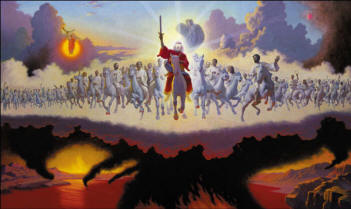
KING JESUS - LORD OF LORDS
IS COMING BACK!

email: creyner@yahoo.com

James 5:1 (KJV) Go to now, ye rich men, weep and howl for your miseries that shall come upon you.
Showing posts with label the Berean Call. Show all posts

Friday, February 7, 2014

Tozer: Showered In His Gifts


Excerpted from Keys To The Deeper Life by A. W. Tozer

IN THEIR attitude toward the gifts of the Spirit, Christians…have tended to divide themselves into three groups: First, there are those who magnify the gifts of the Spirit until they can see little else. Second, there are those who deny that the gifts of the Spirit are intended for the Church in this period of her history. Third, there are those who appear to be thoroughly bored with the whole thing and do not care to discuss it.
     …Another group, so few in number as scarcely to call for classification, consists of those who want to know the truth about the Spirit’s gifts and to experience whatever God has for them within the context of sound New Testament faith. It is for these that this is written.

What Is the True Church?

A proper understanding of the gifts of the Spirit in the Church must depend upon a right concept of the nature of the Church…. The true Church is a spiritual phenomenon…composed of regenerated persons who differ from other human beings in that they have a superior kind of life imparted to them at the time of their inward renewal.

•  They are children of God in a sense not true of any other created beings.
•  Their origin is divine and their citizenship is in heaven.
•  They worship God in the Spirit, rejoice in Jesus Christ, and have no confidence in the flesh.
•  They constitute a chosen generation, a royal priesthood, a holy nation, a peculiar people.
•  They have espoused the cause of a rejected and crucified Man who claimed to be God and who has pledged His sacred honor that He will prepare a place for them in His Father’s house and return again to conduct them there with rejoicing.

     In the meantime, they carry His cross, suffer whatever indignities men may heap upon them for His sake, act as His ambassadors, and do good to all men in His name. They steadfastly believe that they will share His triumph and [thus] are perfectly willing to share His rejection by a society that does not understand them. They have no hard feelings—only charity and compassion and a strong desire that all men may come to repentance and be reconciled to God.
     This is a fair summary of one aspect of New Testament teaching about the Church. But another truth, more revealing and significant to those seeking information about the gifts of the Spirit, is that the Church is a spiritual body, an organic entity united by the life that dwells within it.
     Each member is joined to the whole by a relationship of life. As a man’s soul may be said to be the life of his body, so the indwelling Spirit is the life of the Church. The idea that the Church is the body of Christ is not an erroneous one…. The Apostle Paul in three of his epistles sets forth this truth in such sobriety of tone and fullness of detail as to preclude the notion that he is employing a casual figure of speech not intended to be taken too literally.
     [His] clear, emphatic teaching…is that Christ is the Head of the Church, which is His body. The parallel is drawn carefully…. Conclusions are drawn from the doctrine, and certain moral conduct is made to depend upon it.
     As a normal man consists of a body with various obedient members [and] a head to direct them, so the true Church is a body, individual Christians being the members and Christ the Head.
     The mind works through the members of the body, using them to fulfill its intelligent purposes. Paul speaks of the foot, the hand, the ear, the eye as being members of the body, each with its proper but limited function; but it is the Spirit that worketh in them (1 Cor. 12:1-31).
     The teaching that the Church is the body of Christ in 2 Corinthians 12 follows a listing of certain spiritual gifts and reveals the necessity for those gifts.
     The intelligent head can work only as it has at its command organs designed for various tasks. It is the mind that sees, but it must have an eye to see through. It is the mind that hears, but it cannot hear without an ear. And so [it is] with all the varied members—the instruments by means of which the mind moves into the external world to carry out its plans.
     As all man’s work is done by his mind, so the work of the Church is done by the Spirit, and by Him alone. But to work, He must set in the body certain members with abilities specifically created to act as media through which the Spirit can flow toward ordained ends.

How Many Gifts?

     Paul mentions no less than 17 (1 Cor. 12:4-11, 27-31; Rom. 12:3-8; Eph. 4:7-11). These are not natural talents merely but gifts imparted by the Holy Spirit to fit the believer for his place in the body of Christ…. [T]hrough the body of Christ, God is doing an eternal work above and beyond the realm of fallen nature. This requires supernatural working.
     Religious work can be done by natural men without the gifts of the Spirit, and it can be done well and skillfully. But work designed for eternity can only be done by the eternal Spirit…through gifts He has Himself implanted in the souls of redeemed men….
     Certain evangelical teachers have told us that the gifts of the Spirit ceased at the death of the apostles or at the completion of the New Testament. This, of course, is a doctrine without a syllable of biblical authority back of it…. The result of this erroneous teaching is that spiritually gifted persons are ominously few among us. When we so desperately need leaders with the gift of discernment, for instance, we do not have them and are compelled to fall back upon the techniques of the world. This frightening hour calls aloud for men with the gift of prophetic insight. Instead we have men who conduct surveys, polls, and panel discussions. We need men with the gift of knowledge. In their place we have men with scholarship—nothing more…. [highlighting is mine. CMR]
     [T]he Scriptures plainly imply the imperative of possessing the gifts of the Spirit. Paul urges that we both “covet” and “desire” spiritual gifts (1 Cor. 12:31; 14:1). It does not appear to be an optional matter with us but rather a scriptural mandate to those who have been filled with the Spirit.
     But I must also add a word of caution. The various spiritual gifts are not equally valuable, as Paul so carefully explained. Certain brethren have magnified one gift out of 17 out of all proportion.… [T]he general moral results of this teaching have…not been good…. [I]t has resulted in much shameless exhibitionism, a tendency to depend upon experiences instead of upon Christ, and often a lack of ability to distinguish the works of the flesh from the operations of the Spirit.
     Those who deny that the gifts are for us today and those who insist upon making a hobby of one gift are both wrong, and we are all suffering the consequences of their errors.
     …We have every right to expect our Lord to grant to His church spiritual gifts, which He has never in fact taken away from us but which we are failing to receive only because of our error or unbelief.
     It is more than possible that God is even now imparting the gifts of the Spirit to whomsoever He can and in whatever measure He can as His conditions are met even imperfectly. Otherwise, the torch of truth would flicker out and die.
     Clearly, however, we have yet to see what God would do for His Church if we would all throw ourselves down before Him with an open Bible and cry, “Behold Thy servant, Lord! Be it unto me even as Thou wilt."


Friday, January 27, 2012

The Fool: "There Is No God."


This article is taken from the FREE monthly newsletter put out by
The Berean Call. You can find the Jauary 2012 issue HERE.

~ ~ ~ ~ ~
by Dave Hunt
Excerpts from Seeking and Finding God by Dave Hunt

   WITHOUT TAKING TIME to explain the many disagreements, it is undeniable that there are such great basic differences between the world’s religions that it seems irrational to suggest that they are essentially in agreement and all lead to the same place. Nevertheless, in spite of these differences, there is evidence that those who follow world religions will indeed all end up in the same place—but not where they promise to take their followers.

   All religions have in common a universal opposition to the God of the Bible and His gospel concerning salvation by grace and faith alone through Christ Jesus and His sacrifice on the Cross. This commonality places them all on one side—and Christianity on the other.

   Indeed, so wide is the chasm between Christianity and all the world’s religions that it seems equally clear that Christians will definitely arrive at a different eternal destiny from everyone else. Yes, the various religions differ in the details relevant to the appeasement of their particular god or gods and the methods of attaining to nirvana, moksha, or whatever paradise they may offer. However, they all have in common the belief that their religious goals can somehow be achieved through their own good efforts and/or faithful participation in rituals and sacraments. Whether by yoga or paying off bad karma for the Hindu, or by good deeds for the Muslim (or dying in jihad [holy war] or on the hajj pilgrimage to Mecca), or through appeasing the spirits in African tribal religions and Shintoism, or by meditation techniques to escape desire and return to the void for the Buddhist, or by the sacraments of a supposed Christian church—it is all a matter of self-effort, which the God of the Bible firmly tells us He will not accept as even partial payment for having broken His laws.

   The Bible clearly states: “But to him that worketh not, but believeth on him that justifieth the ungodly, his faith is counted for righteousness” (Romans 4:5). Jesus said, “I came not to call the righteous, but sinners to repentance” (Mark 2:17). Paul emphasized that point: “Christ Jesus came into the world to save sinners” (1 Timothy 1:15). The world’s religions, along with the false Christianity that trusts in works and sacramentalism, attempt to make a person righteous enough for heaven. In contrast, the Bible says that everyone, by very nature, sins, must confess it, and must believe the gospel to receive forgiveness of sins and thereby be admitted eternally into the true God’s presence.

   Biblical salvation is by faith, and faith necessarily involves that which is unseen. It is not faith to believe in that which is present in visible form. Faith reaches out to the unseen world of the spirit and the eternal. And right here we encounter a major problem with ritual and sacraments: they attempt a moral rescue of the unseen and nonphysical spirit and soul of man with physical and visible ceremony. That won’t work.

   This grave error of sacramentalism persists even among a majority of those who call themselves Christians. They imagine that through participation in the visible, and thus temporal, sacrament, they receive invisible and eternal spiritual benefits. Clearly, this is impossible. The Bible declares, “Faith is the substance of things hoped for, the evidence of things not seen” (Hebrews 11:1). Salvation, because it necessarily involves the eternal and invisible, not that which is seen and is therefore temporal, must be by faith, not by physical works or ritual.

   Furthermore, ritual and sacraments have nothing to do with either justice or punishment and therefore cannot possibly pay for sin. One might as well imagine that some ritual could satisfy a court of law in paying the penalty prescribed for a major crime as imagine that God would accept sacraments in payment of the infinite penalty He has prescribed for breaking His law.

   The Bible gives two sacraments for the Christian: baptism and communion (also called the Lord’s supper). Both are symbolic reminders of a spiritual and eternal transaction that has already taken place: Christ’s death, burial, and resurrection, and our identification with Him by faith in His full payment of the penalty for our sins.

   Neither baptism nor communion is efficacious. To imagine that they are—and therefore to rely upon either or both of them to effect, even partially, one’s salvation—is to reject the salvation God offers in grace to those who believe His promise.

   In none of the world’s religions is there any concept of God’s perfect justice having to be satisfied for the sinner to be forgiven. Instead, works and rituals and mystical experiences are offered to appease God and/or to earn one’s salvation. The Bible, however, finds all the world guilty of rebellion against God and insists that human guilt can be forgiven only on a righteous basis. The penalty that God decreed must be paid in full.

   No one can pay for his own sins, either by sacrifice (even of himself in death) or by good works. Only Christ, who is God and man in one person and who lived without any sin, could pay for the sins of the world. Nor can we merit, earn, or purchase from God—who is perfectly holy and just—the benefit of Christ’s sacrifice in forgiveness of our sins. If we are to receive the pardon that Christ has earned, we must receive it by faith as those unworthy of it—the gift of God’s grace.

   The purpose of the Ten Commandments was not to offer salvation to those who could keep them (no one has ever done so except Christ), but to show us our guilt so that we would accept Christ’s payment that satisfied God’s justice on our behalf:
Wherefore, the law was our schoolmaster to bring us unto
Christ, that we might be justified by faith. (Galatians 3:24)

Therefore by the deeds of the law there shall no flesh be
justified in his sight: for by the law is the knowledge of
sin...that every mouth may be stopped, and all the world
may become guilty before God.... For God hath concluded
them all in unbelief, that he might have mercy upon all.

For the wages of sin is death; but the gift of God is eternal
life through Jesus Christ our Lord. (Romans 3:19-20;
11:32; 6:23)

   The attempt to offer works or rituals in payment for salvation is true even of some groups who claim to be Christian but who set up their own rules for gaining heaven in opposition to the biblical gospel of salvation by faith and grace alone without works. The Bible clearly says, “…that whosoever believeth in him [Christ] should not perish, but have everlasting life” (John 3:16). “For by grace are ye saved through faith…not of works, lest any man should boast” (Ephesians 2:8-9); “Not by works of righteousness which we have done, but according to his mercy he saved us…that being justified by his grace, we should be made heirs according to the hope of eternal life” (Titus 3:5-7). Any attempt to make even a partial payment for God’s gift by His grace is a rejection of that gift.

   That good deeds cannot pay for sins is not only biblical but logical. Even a traffic ticket cannot be paid on that basis. It will not avail to ask the judge to dismiss the charge for speeding because the guilty party has driven more often within the speed limit than he has exceeding it. Nor would the judge waive the payment of any crime in response to the defendant’s promise never, ever to break the law again. The judge would simply say, “If you never break the law again you are only doing what the law requires. You receive no extra credit by which to pay for having broken the law in the past. That penalty is a separate issue and must be paid as prescribed.”
 
   The Bible further asserts that God’s justice is infinite and that man, being finite, could never pay the infinite penalty it demands. We would be separated from God forever if we tried to work off the debt owed to His justice. God, being infinite, could pay that infinite penalty, but it wouldn’t be just, because
He is not one of us. Therefore, God became a man through the virgin birth in order to take upon Himself, in our place, the judgment we deserve. And it is only on the basis of that penalty having been paid in full that God can justly offer forgiveness.

   How amazing that religions that rely upon good works and rituals are considered to be “faiths.” Faith can only engage the unseen and eternal and, therefore, does not mix with works and ritual. In search of a valid faith, it is folly to look at that which is visible. Even to look to a visible cross or crucifix is of no merit. What occurred on the cross for our salvation was invisible and must be accepted by faith.

   The visible torture men inflicted upon Christ, the scourging, mocking, and nailing to the cross, is not the basis of our salvation—though that was the message of the popular film The Passion of the Christ. There is no virtue in making the “sign of the cross” or waving a cross or crucifix to ward off Satan or
evil. It was the judgment Christ endured at the hands of God in payment of the penalty for our sins that makes it possible for God to offer salvation. That suffering, endured by Christ, was totally invisible to man and must ever be. It is by faith alone that we believe Christ paid the penalty and by which we receive the eternal salvation He offers.

   The Bible speaks of “the faith which was once [for all time] delivered unto the saints” and declares that we must “earnestly contend” for this unchangeable truth because there are false teachers even inside the church who will seek through subterfuge to oppose it (Jude 3–4). Jude is not referring to faith in the sense of believing that a prayer will be answered or an event will occur. “The faith” is the body of truth that must be believed for one to be a Christian.

   The Bible allows for no compromise, no discussion, no dialogue with the world’s religions (remember, Christianity is not a religion but distinct from all of them) in search for common ground. There is no common ground as far as God, Jesus Christ, and salvation are concerned. The very suggestion that dialogue may be appropriate denies that “the faith” has unique doctrinal content as a definitive body of truth for which we must earnestly contend, and opens the door to compromise in the interest of public relations.

   Jesus didn’t say, “Go into all the world and dialogue about faith.” He said, “Go ye into all the world, and preach the gospel” (Mark 16:15). Paul didn’t dialogue with the rabbis and philosophers and pagan priests. He “disputed in the synagogue with the Jews, and with the devout persons, and in the market daily” (Acts 17:17). Was it because he was angry and argumentative? No, it was because the eternal destiny of his hearers depended upon whether they believed or rejected the gospel.

   A reasonable and genuine faith must take very seriously what Jesus said—not what somebody says about what Jesus said, but His very words as recorded in the Bible. And we must face this truth for ourselves, not look to someone else to interpret it for us, no matter what credentials that person or church or institution might claim qualifies them to think for us. We must arrive at this serious faith personally, for true faith is between each individual and God.

Except ye repent, ye shall all likewise perish.
— LUKE 13:3,5


Compliments of
ROYAL HEIR