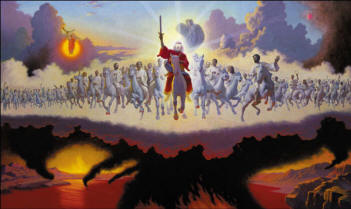
My last post was a re-post from two years ago, an interview of Walid Shoebat, author of a dynamic book, God's War On Terror, which takes a completely different view of the fulfillment of end time prophecy than does the one which has been handed down for the last hundred or so years - and which doesn't seem to be working out for us.
Shoebat was a Muslim terrorist who converted to Christianity due to the faithfulness of his Christian mother and, of course, God's mercy. I thought the book made wonderful sense when I read it, and I've had it in the back of my mind for several years. I'm not saying it's the answer to prophecy; I'm just saying that we should consider it. Americans always think everything is going to happen in the good old USA, but all of biblical history happened in the Middle East. Maybe that will remain the same in the present and the future. Anyway, it's interesting. If you would like to read the article with some great pictures, you can find it HERE at Shoebat's website. CMR
Shoebat was a Muslim terrorist who converted to Christianity due to the faithfulness of his Christian mother and, of course, God's mercy. I thought the book made wonderful sense when I read it, and I've had it in the back of my mind for several years. I'm not saying it's the answer to prophecy; I'm just saying that we should consider it. Americans always think everything is going to happen in the good old USA, but all of biblical history happened in the Middle East. Maybe that will remain the same in the present and the future. Anyway, it's interesting. If you would like to read the article with some great pictures, you can find it HERE at Shoebat's website. CMR
Antichrist Will Soon Enter The Temple of God (Pay
Close Attention)
By Shoebat Foundation on June 3, 2014
By Walid Shoebat (Shoebat Exclusive)
Hagia Sophia, or Ayasofya in
Turkish, is officially a museum: Turkey’s most-visited monument, whose formally
neutral status symbolizes the secular nature of the modern Turkish state. But
this status is changing when tens of thousands of Muslims have been gathering
there on Saturday to pray demanding it will again be turned into a mosque — a
dream they believe Prime Minister Tayyip Erdogan can fulfill.
Erdogan is planning to pray inside the Hagia Sophia Temple, reports the Radikal Turkish daily newspaper which will probably be performed during the annual celebrations just before the August elections when Erdogan wants to retake his office of prime-minister.
Erdogan’s government is stepping up its calls to turn the Hagia Sophia into a functioning mosque, but Orthodox Christians complain that this is a desecration of the holiest site in Christendom.
Erdogan is planning to pray inside the Hagia Sophia Temple, reports the Radikal Turkish daily newspaper which will probably be performed during the annual celebrations just before the August elections when Erdogan wants to retake his office of prime-minister.
Erdogan’s government is stepping up its calls to turn the Hagia Sophia into a functioning mosque, but Orthodox Christians complain that this is a desecration of the holiest site in Christendom.
Anatolia Youth Association (AGD) had
made a call for the event that came at a time when several radical groups have
been discussing the status of the museum.
“This is a serious push to break Ayasofya’s chains,” said Salih Turhan, head of the Anatolia Youth Association, which has collected 15 million signatures to petition for it to be turned back into a mosque.
This despite that the 17th Century Sultan Ahmed Mosque, remains mostly empty of worshippers and Istanbul boasts more than 3,000 mosques. The eyes are glued on desecrating Christianity’s most sacred Temple, the Hagia Sohpia.
“Ayasofya is a symbol for the Islamic world and the symbol of Istanbul’s conquest. Without it, the conquest is incomplete, we have failed to honor Sultan Mehmet’s trust,” he said, citing a 15th Century deed signed by the conquering Caliph and decrying as sin other uses of Hagia Sophia.
It was Erdogan who promoted celebration of the Turkish conquest that turned Constantinople into Istanbul: “Conquest is the removal of shackles on doors and in hearts,” he said to mark the 561st anniversary of the Byzantine defeat. ” Civilization comes with conquest,” he added.
Erdogan’s talk of conquest, expansion and his reviving of the dead man of Europe is painting his Neo-Ottoman dream as a red dragon. Erdogan is daily becoming an Antichrist who wants to enter a great Christian Temple, yet he is met without any resistance from western Christians. Even the 2012 film depicting the Muslim takeover of the Byzantine capital, “Conquest 1453″, attracted an audience of millions.
From its construction, until 1453, when the Ottoman Empire conquered the city, Hagia Sophia served as an Eastern Orthodox Temple and the seat of the Patriarchate of Constantinople, the Ottomans turned it into a mosque before being secularized and converted to a museum in 1935.
Prominent imams, including the harlot state of Saudi Arabian, Imam Abdullah Basfar, the imam of the Ka’bah in Mecca, Islam’s holiest site was present at the event to lead the prayers. The crowd left the area after the prayer chanting slogans that say Hagia Sophia should be a mosque.
Orthodox Christians see Hagia Sophia as a Temple to be the most significant structure in all Christian history.
American Evangelicals are either unaware of the significance of such structure or see that the Temple was built by Constantine the Great, which makes it insignificant.
Only time will tell who is right, Constantine had his share of sins and so did Solomon. But all Christians need to pay close attention to Erdogan’s desecrations of significant Christian or Jewish landmarks. Its not only 2 Thessalonians 2 which speaks of desecrating a temple, other text in Isaiah 14 grabs our interest.
But first, in 2 Thessalonians:
“This is a serious push to break Ayasofya’s chains,” said Salih Turhan, head of the Anatolia Youth Association, which has collected 15 million signatures to petition for it to be turned back into a mosque.
This despite that the 17th Century Sultan Ahmed Mosque, remains mostly empty of worshippers and Istanbul boasts more than 3,000 mosques. The eyes are glued on desecrating Christianity’s most sacred Temple, the Hagia Sohpia.
“Ayasofya is a symbol for the Islamic world and the symbol of Istanbul’s conquest. Without it, the conquest is incomplete, we have failed to honor Sultan Mehmet’s trust,” he said, citing a 15th Century deed signed by the conquering Caliph and decrying as sin other uses of Hagia Sophia.
It was Erdogan who promoted celebration of the Turkish conquest that turned Constantinople into Istanbul: “Conquest is the removal of shackles on doors and in hearts,” he said to mark the 561st anniversary of the Byzantine defeat. ” Civilization comes with conquest,” he added.
Erdogan’s talk of conquest, expansion and his reviving of the dead man of Europe is painting his Neo-Ottoman dream as a red dragon. Erdogan is daily becoming an Antichrist who wants to enter a great Christian Temple, yet he is met without any resistance from western Christians. Even the 2012 film depicting the Muslim takeover of the Byzantine capital, “Conquest 1453″, attracted an audience of millions.
From its construction, until 1453, when the Ottoman Empire conquered the city, Hagia Sophia served as an Eastern Orthodox Temple and the seat of the Patriarchate of Constantinople, the Ottomans turned it into a mosque before being secularized and converted to a museum in 1935.
Prominent imams, including the harlot state of Saudi Arabian, Imam Abdullah Basfar, the imam of the Ka’bah in Mecca, Islam’s holiest site was present at the event to lead the prayers. The crowd left the area after the prayer chanting slogans that say Hagia Sophia should be a mosque.
Orthodox Christians see Hagia Sophia as a Temple to be the most significant structure in all Christian history.
American Evangelicals are either unaware of the significance of such structure or see that the Temple was built by Constantine the Great, which makes it insignificant.
Only time will tell who is right, Constantine had his share of sins and so did Solomon. But all Christians need to pay close attention to Erdogan’s desecrations of significant Christian or Jewish landmarks. Its not only 2 Thessalonians 2 which speaks of desecrating a temple, other text in Isaiah 14 grabs our interest.
But first, in 2 Thessalonians:
“for [that day shall not come],
except there come a falling away first, and that man of sin be revealed, the
son of perdition; Who oppose and exalts himself above all that is called God,
or that is worshiped; so that he as God sits in the temple of God, showing
himself that he is God.” (II Thessalonians 2:4)
Many would pause here and stop
reading further since such a scenario is far-fetched; a Muslim Antichrist who
enters Hagia Sophia is fulfillment? Isn’t Antichrist supposed to enter the
Temple in Jerusalem? Indeed. And how could a Muslim declare to be God when
Muslims deny that a man can be God?
This requires patience, study and attention. Not comprehending these issues is either caused by the lack of comprehending Islam or even inductively understanding the Bible.
First of all, Antichrist, while he claims titles that belong to deity, he also worships a deity: “He will honor a God of fortresses” (Daniel 11). This is not some allegory for he “acts against the strongest fortresses with a foreign god, which he shall acknowledge, and advance its glory” (Daniel 11:39).
This requires patience, study and attention. Not comprehending these issues is either caused by the lack of comprehending Islam or even inductively understanding the Bible.
First of all, Antichrist, while he claims titles that belong to deity, he also worships a deity: “He will honor a God of fortresses” (Daniel 11). This is not some allegory for he “acts against the strongest fortresses with a foreign god, which he shall acknowledge, and advance its glory” (Daniel 11:39).
He serves a “foreign god,” which he
shall “acknowledge” and via warfare he “advances its glory”, the glory of this
single-war-god while he proclaims deity. Everything fits, including that he
does not honor the “desire of women” (woman’s needs, rights).
It can’t get any clearer than this. Only in Islam can we find Muslim multitudes, while they deny they worship Muhammad and Mahdi, yet indeed they deify them. Muhammad in Islam holds a uniquely exalted status unparalleled by anything or anyone else. He is given the title Al-Maqam-Al-Mahmud (The Glorious).
Christians who know little about Islam, and who go around giving interpretations, complain much asking “how can Antichrist be Muslim when Muslims exclaim, “we do not worship any man, we worship Allah””.
Truth is, Muslims deify Muhammad and Mahdi giving them titles that only belong to god: Al-Maqam-Al-Mahmud (The Glorious One), Awal-Khalq-illah (The first of Creation), Muhammad (The Praised One), Al-Insan Al-Kamel (The Perfect Man), Rahmatan-lil-A’alameen (Mercy to All Mankind), Al-rasul Al-A’tham (The Greatest of All sent by God), Shafi (Healer), Munji (Savior), Mahdi (The Guided One/Deliverer), Al-Mustafa Al-Mukhtar (The Chosen One), Amir (The Prince), Khatimun-Nabiyeen (The Seal of Prophets), Al-Hadi (The Guide), Awal (First), Akher (Last), Sayyid Walad Adam (The Leader of The Sons of Adam) and Al-Siraj Al-Muneer (The Luminous One, The Glowing Lamp). (1)
It’s a god whom his fathers knew not shall he honor with gold, and silver, and with precious stones, and pleasant things.” (Daniel 11:38)
We can either see a biblical contradiction or we need to reconcile the verses. One of the five main obligatory pillars of Islam is for every Muslim to pay Zakat by giving one-fifth of their income—their gold, and their silver to honor and advance the cause of Allah:“Zakat is for the poor and the needy, and… to free the captives and the debtors, and for the cause of Allah, and (for) the wayfarers; a duty imposed by Allah. Allah is knower, Wise.” (Qur’an 9:60).Zakat is not only for the poor, but a tax to expand the rule of Allah via warfare which the Qur’an is quite clear about:“And those who hoard up gold and silver and do not spend them in the cause of Allah.” (Qur’an 9:34).
Erdogan by invoking to pray at Hagia Sophia wants to be Sultan Mahdi in order to be exalted above all of creation and literally wants to sit in the Temple of God in Hagia Sophia.
Evangelicals propose the possibility of such temple to be only in Jerusalem, while many Orthodox Christians object to such rebuilding referring to John 4:21: “Woman,” Jesus replied, “believe me, a time is coming when you will worship the Father neither on this mountain nor in Jerusalem.” (John 4:21) They would argue that historically it has been the pagans who wanted to rebuild a Jewish Temple in Jerusalem during the mid fourth century and God struck them dead.(2)
Evangelicals would argue that indeed, God struck them dead because this was not the right timing.
It can’t get any clearer than this. Only in Islam can we find Muslim multitudes, while they deny they worship Muhammad and Mahdi, yet indeed they deify them. Muhammad in Islam holds a uniquely exalted status unparalleled by anything or anyone else. He is given the title Al-Maqam-Al-Mahmud (The Glorious).
Christians who know little about Islam, and who go around giving interpretations, complain much asking “how can Antichrist be Muslim when Muslims exclaim, “we do not worship any man, we worship Allah””.
Truth is, Muslims deify Muhammad and Mahdi giving them titles that only belong to god: Al-Maqam-Al-Mahmud (The Glorious One), Awal-Khalq-illah (The first of Creation), Muhammad (The Praised One), Al-Insan Al-Kamel (The Perfect Man), Rahmatan-lil-A’alameen (Mercy to All Mankind), Al-rasul Al-A’tham (The Greatest of All sent by God), Shafi (Healer), Munji (Savior), Mahdi (The Guided One/Deliverer), Al-Mustafa Al-Mukhtar (The Chosen One), Amir (The Prince), Khatimun-Nabiyeen (The Seal of Prophets), Al-Hadi (The Guide), Awal (First), Akher (Last), Sayyid Walad Adam (The Leader of The Sons of Adam) and Al-Siraj Al-Muneer (The Luminous One, The Glowing Lamp). (1)
It’s a god whom his fathers knew not shall he honor with gold, and silver, and with precious stones, and pleasant things.” (Daniel 11:38)
We can either see a biblical contradiction or we need to reconcile the verses. One of the five main obligatory pillars of Islam is for every Muslim to pay Zakat by giving one-fifth of their income—their gold, and their silver to honor and advance the cause of Allah:“Zakat is for the poor and the needy, and… to free the captives and the debtors, and for the cause of Allah, and (for) the wayfarers; a duty imposed by Allah. Allah is knower, Wise.” (Qur’an 9:60).Zakat is not only for the poor, but a tax to expand the rule of Allah via warfare which the Qur’an is quite clear about:“And those who hoard up gold and silver and do not spend them in the cause of Allah.” (Qur’an 9:34).
Erdogan by invoking to pray at Hagia Sophia wants to be Sultan Mahdi in order to be exalted above all of creation and literally wants to sit in the Temple of God in Hagia Sophia.
Evangelicals propose the possibility of such temple to be only in Jerusalem, while many Orthodox Christians object to such rebuilding referring to John 4:21: “Woman,” Jesus replied, “believe me, a time is coming when you will worship the Father neither on this mountain nor in Jerusalem.” (John 4:21) They would argue that historically it has been the pagans who wanted to rebuild a Jewish Temple in Jerusalem during the mid fourth century and God struck them dead.(2)
Evangelicals would argue that indeed, God struck them dead because this was not the right timing.
But the solution to the dilemma is
that it could be both. Antichrist enters Hagia Sophia and a newly rebuilt
temple in Jerusalem as well. 2 Thessalonians does not speak of the Temple being
in Jerusalem. But this does not negate that it could be in Jerusalem since
Revelation speaks of measuring the altar and that the Gentiles would tread foot
in Jerusalem for 42 months
But Isaiah 14 holds a key. While most brush through the verses in Isaiah 14 by doing selective reading without focusing on every word, verse 13 says:
“I will also sit on the mount of the congregation on the farthest sides of the north.”
What is this “mount of the congregation”?
This declaration is not regarding Lucifer in his angelic stage, but Antichrist “is this the man that made the earth tremble” (v.17) and is said to rule from Pergamum (Revelation 2:12-13) which Christ proclaimed would be the future seat of Satan (Antichrist). This “mount of the congregation” is on the sides of the northern lands in Asia Minor—Turkey. It is in Turkey that the Seven Churches and the Seven Lamp stands were and this is no small issue to ignore.
Others see this “mount of the congregation” as the temple in Jerusalem. This is not without merit: “… the joy of the whole earth, in mount Zion, on the sides of the north, the city of the great King.”
When Turks captured Constantinople in 1453, Sultan Mehmet, an Antichrist (there are many Antichrists before the final one) of the seventh-head (empire) immediately went to the Hagia Sophia and ordered that it be converted into a mosque, he added abominations; the Islamic elements were added such as minarets, the mihrab and the minber all of which were appropriately positioned to face toward Mecca, including two huge marble jars which were brought from Pergamum in the 16C and added written blasphemies in Islamic calligraphy. The names painted on these plaques are Allah, Prophet Mohammed, the first four Caliphs Ebubekir, Omer, Osman and Ali, and the two grandsons of Mohammed, Hasan and Huseyin.
Muslim blasphemies replaces Christian signs: “We see not our signs” (Psalm 74:9) “Thine enemies roar in the midst of thy congregations; they set up their ensigns for signs.” (v. 4)
As for Jerusalem’s Temple, many question, how could Wahhabi Islam allow for a Temple to be rebuilt in Jerusalem? But the problem is that too many focus on Wahhabism alone. Turkish brand Sufi Islam is a bit craftier and the Turks even already have the Quranic alkaline verses ready:
But Isaiah 14 holds a key. While most brush through the verses in Isaiah 14 by doing selective reading without focusing on every word, verse 13 says:
“I will also sit on the mount of the congregation on the farthest sides of the north.”
What is this “mount of the congregation”?
This declaration is not regarding Lucifer in his angelic stage, but Antichrist “is this the man that made the earth tremble” (v.17) and is said to rule from Pergamum (Revelation 2:12-13) which Christ proclaimed would be the future seat of Satan (Antichrist). This “mount of the congregation” is on the sides of the northern lands in Asia Minor—Turkey. It is in Turkey that the Seven Churches and the Seven Lamp stands were and this is no small issue to ignore.
Others see this “mount of the congregation” as the temple in Jerusalem. This is not without merit: “… the joy of the whole earth, in mount Zion, on the sides of the north, the city of the great King.”
When Turks captured Constantinople in 1453, Sultan Mehmet, an Antichrist (there are many Antichrists before the final one) of the seventh-head (empire) immediately went to the Hagia Sophia and ordered that it be converted into a mosque, he added abominations; the Islamic elements were added such as minarets, the mihrab and the minber all of which were appropriately positioned to face toward Mecca, including two huge marble jars which were brought from Pergamum in the 16C and added written blasphemies in Islamic calligraphy. The names painted on these plaques are Allah, Prophet Mohammed, the first four Caliphs Ebubekir, Omer, Osman and Ali, and the two grandsons of Mohammed, Hasan and Huseyin.
Muslim blasphemies replaces Christian signs: “We see not our signs” (Psalm 74:9) “Thine enemies roar in the midst of thy congregations; they set up their ensigns for signs.” (v. 4)
As for Jerusalem’s Temple, many question, how could Wahhabi Islam allow for a Temple to be rebuilt in Jerusalem? But the problem is that too many focus on Wahhabism alone. Turkish brand Sufi Islam is a bit craftier and the Turks even already have the Quranic alkaline verses ready:
“And who is more unjust than he who
forbids that in places for the worship of God, God’s name should be
celebrated?-whose zeal is (in fact) to ruin them? It was not fitting that such
should themselves enter them except in fear. For them there is nothing but
disgrace in this world, and in the world to come, an exceeding torment.” (Koran
2:214)
Today, the most fit to bring reconciliation between Shiite and Sunni, Jew and Arab are the Sufi Muslim Turks in which it will produce the Antichrist. The Sufis of Turkey are Sunni, this brand of Islam is different from the Wahhabist which is vehemently anti-Shiite.
Turkey has great reverence to the Shiite icons of Ali, Hassan and Hussein, the Shiite historic and religious martyrs and icons whose names are erected on plagues in Hagia-Sophia. They are the most fit to allow a Temple to be rebuilt on the Temple Mount. Sinem Tezyapar is an executive producer on Turkish Television states:
Today, the most fit to bring reconciliation between Shiite and Sunni, Jew and Arab are the Sufi Muslim Turks in which it will produce the Antichrist. The Sufis of Turkey are Sunni, this brand of Islam is different from the Wahhabist which is vehemently anti-Shiite.
Turkey has great reverence to the Shiite icons of Ali, Hassan and Hussein, the Shiite historic and religious martyrs and icons whose names are erected on plagues in Hagia-Sophia. They are the most fit to allow a Temple to be rebuilt on the Temple Mount. Sinem Tezyapar is an executive producer on Turkish Television states:
“As a devout Muslim, I take pleasure
when Jews pray to Almighty God, and their praying anywhere in the world,
including at the Temple Mount, would be a glad tiding for me as well. As a devout Muslim, it would be a joy for
me to see Prophet Solomon’s Temple rebuilt as well. No, you did not hear me
wrong. Prophet Solomon’s Temple being rebuilt in all its magnificence and glory
would be a great delight for me, as it would be to any Muslim.”
Hagia Sophia is the most important Christian Temple in the East, built in the mid-4th century and then rebuilt during the reign of Justinian the Great. It should be a concern for every Christian on the face of the globe.
And in case people want to argue that Hagia Sophia was not considered the “Temple of God” for Christians, they need to search history. Sophia is the Wisdom of God. This phenomenon has always caused a lot of interpretational difficulties for researchers, resulting for example in the diversity of translations for Hagia Sophia temples in the literature (church/cathedral of the Holy Wisdom, God’s Wisdom, Divine Wisdom or even – incorrectly – St. Sophia).
Nevertheless, the problem to whom, in the mind of the Byzantines themselves, the sanctuaries of that name were dedicated is worth a closer look. It is even more interesting when we take into consideration the cathedral church in Constantinople, the most important temple of the empire and the whole East Christian civilization.
HAGIA SOHPIA, A TEMPLE OF GOD?
An excellent research by Zofia Brzozowska of the Katedra Historii Bizancjum sheds much light to answer this question. The understanding of the Hagia Sophia cathedral as a temple dedicated to the Son of God is also characteristic of several writers contemporary to the founder of the reconstruction of the Constantinopolitan basilica – Justinian I the Great. Procopius of Caesarea (ca. 500 – ca. 560) repeatedly mentions in his writings that the main metropolitan church was known as the church of the Holy Wisdom, because it was a name recognized at that time by the Byzantines as the most suitable for God as a name of his sanctuary. (3)
An interesting composition, containing a detailed description concerning the construction of the temple of Hagia Sophia, was written probably during the reign of emperor Basil I (867–886). In this work we can discover a number of essential components of East Christian sophiology. First of all, just like in the case of Byzantine writers of the 5th–6th century, the anonymous author says that the Constantinopolitan basilica was (in the eyes of the inhabitants of the empire) a church dedicated to the Only Begotten Son and Word of God. (4)
In the 11th century an attempt to explain the invocation of the Constantinopolitan cathedral an amazing construction to foreigners—was undertaken by a West European author. An anonymous traveler from Tarragona in his description of the capital of Byzantium emphasized that its main temple is dedicated to the Son of God, and the name Hagia Sophia points to one of the attributes of the Creator, the Wisdom of God (Latin Sancta Sapientia), and not – as it was claimed in the West in his times – a saint named Sophia. (5)
A clear statement that Hagia Sophia is a temple dedicated to Jesus, the Son of God can also be found in a medieval Byzantine normative source. A Chrysobull by Emperor Manuel Comnenus, dated 1153, states that the Constantinopolitan cathedral was built in honour of the Saviour. (6)
Interestingly, the theme also appears on the pages of a 13th century. Source of Slavic provenance (Old Russian), known as the Pilgrim’s Books (Книги Паломник), written by Dobryna Jadrejkovič from Novgorod the Great, also known in the literature under the monastic name (Anthony of Novgorod), who traveled to Constantino- ple between 1200 and 1204. In the itinerary written after the return, he described many Byzantine objects of the capital, including the Hagia Sophia basilica, whose name according to him should be understood as the Temple of Wisdom and Word of God. (7)
Hagia Sophia is the most important Christian Temple in the East, built in the mid-4th century and then rebuilt during the reign of Justinian the Great. It should be a concern for every Christian on the face of the globe.
And in case people want to argue that Hagia Sophia was not considered the “Temple of God” for Christians, they need to search history. Sophia is the Wisdom of God. This phenomenon has always caused a lot of interpretational difficulties for researchers, resulting for example in the diversity of translations for Hagia Sophia temples in the literature (church/cathedral of the Holy Wisdom, God’s Wisdom, Divine Wisdom or even – incorrectly – St. Sophia).
Nevertheless, the problem to whom, in the mind of the Byzantines themselves, the sanctuaries of that name were dedicated is worth a closer look. It is even more interesting when we take into consideration the cathedral church in Constantinople, the most important temple of the empire and the whole East Christian civilization.
HAGIA SOHPIA, A TEMPLE OF GOD?
An excellent research by Zofia Brzozowska of the Katedra Historii Bizancjum sheds much light to answer this question. The understanding of the Hagia Sophia cathedral as a temple dedicated to the Son of God is also characteristic of several writers contemporary to the founder of the reconstruction of the Constantinopolitan basilica – Justinian I the Great. Procopius of Caesarea (ca. 500 – ca. 560) repeatedly mentions in his writings that the main metropolitan church was known as the church of the Holy Wisdom, because it was a name recognized at that time by the Byzantines as the most suitable for God as a name of his sanctuary. (3)
An interesting composition, containing a detailed description concerning the construction of the temple of Hagia Sophia, was written probably during the reign of emperor Basil I (867–886). In this work we can discover a number of essential components of East Christian sophiology. First of all, just like in the case of Byzantine writers of the 5th–6th century, the anonymous author says that the Constantinopolitan basilica was (in the eyes of the inhabitants of the empire) a church dedicated to the Only Begotten Son and Word of God. (4)
In the 11th century an attempt to explain the invocation of the Constantinopolitan cathedral an amazing construction to foreigners—was undertaken by a West European author. An anonymous traveler from Tarragona in his description of the capital of Byzantium emphasized that its main temple is dedicated to the Son of God, and the name Hagia Sophia points to one of the attributes of the Creator, the Wisdom of God (Latin Sancta Sapientia), and not – as it was claimed in the West in his times – a saint named Sophia. (5)
A clear statement that Hagia Sophia is a temple dedicated to Jesus, the Son of God can also be found in a medieval Byzantine normative source. A Chrysobull by Emperor Manuel Comnenus, dated 1153, states that the Constantinopolitan cathedral was built in honour of the Saviour. (6)
Interestingly, the theme also appears on the pages of a 13th century. Source of Slavic provenance (Old Russian), known as the Pilgrim’s Books (Книги Паломник), written by Dobryna Jadrejkovič from Novgorod the Great, also known in the literature under the monastic name (Anthony of Novgorod), who traveled to Constantino- ple between 1200 and 1204. In the itinerary written after the return, he described many Byzantine objects of the capital, including the Hagia Sophia basilica, whose name according to him should be understood as the Temple of Wisdom and Word of God. (7)
In the work dedicated to Theodosius
of Tărnovo the author calls the Constantinopolitan Hagia Sophia – a temple of
the “Wisdom of God’s Word.” (8)
Needless to say Sophia cathedrals used to be built also in the area of Slavia Orthodoxa. A basilica dedicated to the Wisdom of God in Serdica (Sofia) comes probably from the era of the first Bulgarian state, although a number of researchers believe that it should be dated much earlier – to the 4th cent. At the turn of the 10th and 11th cent., a temple under the same invocation was built in Ohrid and some time later in Sliven. The most spectacular temples of Pre-Mongol Rus’ were also dedicated to the Divine Wisdom. The construction of the Sophia cathedral in the capital of Rus’ – Kiev, began probably in 1037. The temple of the Holy Wisdom in Novgorod the Great was built between 1045 and 1050 (probably in the place of an earlier wooden church under the same invocation, which had been erected as early as in 989). Moreover, in the 1060s foundations for a third Old Russian cathedral of Sophia at Polotsk were being prepared.
But the question about Hagia Sophia in Constantinople looks different. The preserved source material justifies the thesis that in Byzantium, regardless of the era, the cathedral basilica was conceived primarily as a temple dedicated to Christ – the Incarnate Word of God.
Most of the Eastern Church Fathers and later Byzantine writers (Justin the Martyr, Athenagoras of Athens, Clement of Alexandria, Origen, Methodius of Olympus, Eusebius of Caesarea, Cyril of Jerusalem, Athanasius of Alexandria, Gregory of Nazianzus, Gregory of Nyssa, Cyril of Alexandria, Theodoret, Atha- nasius the Sinaite, patriarch of Constantinople Germanus, Theodore the Studite, Symeon the Metaphrast, Symeon the New Theologian and Philotheus Coccinus) leave no doubt to the readers that the personified Wisdom of God they meet in the Old Testament, is a symbolic representation of Christ – the Logos before Incarnation.
Therefore, Hagia Sophia, having been dedicated to the Son of God, does qualify as Temple of God since Jesus is God.
In Second Thessalonians, it does not specify which Temple Antichrist sits in, it could be Hagia Sophia or Jerusalem, or even with all the other verses, both.
While we all argue the different biblical points, one thing is for sure, our silence on Hagia Sophia while millions of Muslims surround it like wolves, is shameful.
EZEKIEL 38 FORMING ITS ALLIANCES
On top of all of this, Turkey is extending its political influence and is courting Algeria. Erdogan has his eyes on North Africa. Algeria is one of the leading trading partners of Turkey in Africa.
Turkey is one of Algeria’s top ten external trading partners. Trade between the two countries reached almost $5bn. Algeria is the ninth biggest producer of natural gas in the world and has the tenth biggest proven reserves and is the third biggest natural gas supplier for Turkey, after Russia and Iran. Ankara is looking to establish more stable alliances that would withstand the ongoing regional turbulence. Algiers has an easy stepping stone: the common Ottoman past. Since the independence from France in 1962, Algerians have been rediscovering their Ottoman past. Recently, Turkey’s foreign policy efforts in the Middle East and North Africa region. Turkey is now one of the most popular tourist destinations for Algerians, with the number of Algerian tourists doubling by almost 50 percent from 2011 to 2013.
Also, as we argued for two decades, today Turkey is even building strong economic relations with countries with which it shares common culture and historical bonds and affirmed by Economy Minister Nihat Zeybekçi on Sunday. Speaking at the Turkey-Turkmenistan Joint Economic Commission meeting in Ankara, Zeybekç said developing relations with countries like Turkmenistan had been among the foreign policy priorities of Turkey in recent years.
“It is essential to launch a transport network comprising Turkey, Turkmenistan, Azerbaijan and Kazakhstan,” he said.
The activeness of Turkey in Central Asia has grown; and the reason is not only the interests of Turkey, but also that the U.S is trying to influence the region through Ankara. Islamic Central Asia is not a priority for the U.S. European states, prevention of rapprochement with Russia, and other states of the Asian-Pacific Region are priorities.
In all this we see an Antichrist state (Turkey) ally with Iran, North Africa (Libya/Algiers) and the North Quarters of Beth Togarmah.
So how soon is “soon” to see the full force of Antichrist? The next decade will reveal much and the players will be ready, so stay tuned.
REFERENCES
(1) Muslim scholar, Dr. G. F. Haddad, in an article with a blasphemous title, The Best of Creation states: “[There is no] other Prophet [other than Muhammad] or angel-brought-near with whom Allah Most High shared as many of His own Names in the Qur’an as He did with the Prophet. With respect to his foremost name– Muhammad–peace be upon him, consider the poetic verse of Hassan ibn Thabit (RA): ‘And He drew out for him [a name] from His own Name so as to dignify him greatly: The Owner of the Throne is the Glorious [Mahmûd], and this is the Praiseworthy [Muhammad]!’” 127 In other words, the name Muhammad is not a mere name for a man, according to the Qur’an, Allah, whose name is Mahmud, or the Glorious or the Praised One, named Muhammad after Himself. This is quite the claim. This is a further exaltation than the name Yeshua, which in English means Jehovah is our Salvation. Muhammad literally means The Praised One—The Most Praised.
Needless to say Sophia cathedrals used to be built also in the area of Slavia Orthodoxa. A basilica dedicated to the Wisdom of God in Serdica (Sofia) comes probably from the era of the first Bulgarian state, although a number of researchers believe that it should be dated much earlier – to the 4th cent. At the turn of the 10th and 11th cent., a temple under the same invocation was built in Ohrid and some time later in Sliven. The most spectacular temples of Pre-Mongol Rus’ were also dedicated to the Divine Wisdom. The construction of the Sophia cathedral in the capital of Rus’ – Kiev, began probably in 1037. The temple of the Holy Wisdom in Novgorod the Great was built between 1045 and 1050 (probably in the place of an earlier wooden church under the same invocation, which had been erected as early as in 989). Moreover, in the 1060s foundations for a third Old Russian cathedral of Sophia at Polotsk were being prepared.
But the question about Hagia Sophia in Constantinople looks different. The preserved source material justifies the thesis that in Byzantium, regardless of the era, the cathedral basilica was conceived primarily as a temple dedicated to Christ – the Incarnate Word of God.
Most of the Eastern Church Fathers and later Byzantine writers (Justin the Martyr, Athenagoras of Athens, Clement of Alexandria, Origen, Methodius of Olympus, Eusebius of Caesarea, Cyril of Jerusalem, Athanasius of Alexandria, Gregory of Nazianzus, Gregory of Nyssa, Cyril of Alexandria, Theodoret, Atha- nasius the Sinaite, patriarch of Constantinople Germanus, Theodore the Studite, Symeon the Metaphrast, Symeon the New Theologian and Philotheus Coccinus) leave no doubt to the readers that the personified Wisdom of God they meet in the Old Testament, is a symbolic representation of Christ – the Logos before Incarnation.
Therefore, Hagia Sophia, having been dedicated to the Son of God, does qualify as Temple of God since Jesus is God.
In Second Thessalonians, it does not specify which Temple Antichrist sits in, it could be Hagia Sophia or Jerusalem, or even with all the other verses, both.
While we all argue the different biblical points, one thing is for sure, our silence on Hagia Sophia while millions of Muslims surround it like wolves, is shameful.
EZEKIEL 38 FORMING ITS ALLIANCES
On top of all of this, Turkey is extending its political influence and is courting Algeria. Erdogan has his eyes on North Africa. Algeria is one of the leading trading partners of Turkey in Africa.
Turkey is one of Algeria’s top ten external trading partners. Trade between the two countries reached almost $5bn. Algeria is the ninth biggest producer of natural gas in the world and has the tenth biggest proven reserves and is the third biggest natural gas supplier for Turkey, after Russia and Iran. Ankara is looking to establish more stable alliances that would withstand the ongoing regional turbulence. Algiers has an easy stepping stone: the common Ottoman past. Since the independence from France in 1962, Algerians have been rediscovering their Ottoman past. Recently, Turkey’s foreign policy efforts in the Middle East and North Africa region. Turkey is now one of the most popular tourist destinations for Algerians, with the number of Algerian tourists doubling by almost 50 percent from 2011 to 2013.
Also, as we argued for two decades, today Turkey is even building strong economic relations with countries with which it shares common culture and historical bonds and affirmed by Economy Minister Nihat Zeybekçi on Sunday. Speaking at the Turkey-Turkmenistan Joint Economic Commission meeting in Ankara, Zeybekç said developing relations with countries like Turkmenistan had been among the foreign policy priorities of Turkey in recent years.
“It is essential to launch a transport network comprising Turkey, Turkmenistan, Azerbaijan and Kazakhstan,” he said.
The activeness of Turkey in Central Asia has grown; and the reason is not only the interests of Turkey, but also that the U.S is trying to influence the region through Ankara. Islamic Central Asia is not a priority for the U.S. European states, prevention of rapprochement with Russia, and other states of the Asian-Pacific Region are priorities.
In all this we see an Antichrist state (Turkey) ally with Iran, North Africa (Libya/Algiers) and the North Quarters of Beth Togarmah.
So how soon is “soon” to see the full force of Antichrist? The next decade will reveal much and the players will be ready, so stay tuned.
REFERENCES
(1) Muslim scholar, Dr. G. F. Haddad, in an article with a blasphemous title, The Best of Creation states: “[There is no] other Prophet [other than Muhammad] or angel-brought-near with whom Allah Most High shared as many of His own Names in the Qur’an as He did with the Prophet. With respect to his foremost name– Muhammad–peace be upon him, consider the poetic verse of Hassan ibn Thabit (RA): ‘And He drew out for him [a name] from His own Name so as to dignify him greatly: The Owner of the Throne is the Glorious [Mahmûd], and this is the Praiseworthy [Muhammad]!’” 127 In other words, the name Muhammad is not a mere name for a man, according to the Qur’an, Allah, whose name is Mahmud, or the Glorious or the Praised One, named Muhammad after Himself. This is quite the claim. This is a further exaltation than the name Yeshua, which in English means Jehovah is our Salvation. Muhammad literally means The Praised One—The Most Praised.
(2) “Julian, who in his third
consulship had taken as his colleague Sallustius, the prefect of Gaul, now
entered on his fourth year, and by a novel arrangement took as his colleague a
private individual; an act of which no one recollected an instance since that
of Diocletian and Aristobulus. And although, foreseeing in his anxious mind the
various accidents that might happen, he urged on with great diligence all the
endless preparations necessary for his expedition, yet distributing his
diligence everywhere; and being eager to extend the recollection of his reign
by the greatness of his exploits, he proposed to rebuild at a vast expense the
once magnificent temple of Jerusalem, which after many deadly contests was with
difficulty taken by Vespasian and Titus, who succeeded his father in the
conduct of the siege. And he assigned the task to Alypius of Antioch, who had
formerly been proprefect of Britain. But though Alypius applied himself
vigorously to the work, and though the governor of the province co-operated
with him, fearful balls of fire burst forth with continual eruptions close to
the foundations, burning several of the workmen and making the spot altogether
inaccessible. And thus the very elements, as if by some fate, repelling the
attempt, it was laid aside.” (Ammianus Marcellinus, Roman History, 23.1-3,
trans. C.D.YONGE)
(3) Procopius Caesariensis, De
bellis, III, 6, 26, ed. H.B. Dewing, London 1916 (cetera: Procopius, De
bellis): Σοφίαν καλοῦσιν οἱ Βυζάντιοι τὸν νεὼν, ταύτην δὴ μάλιστα τῷ Θεῷ
πρέπειν τὴν ἐπωνυμίαν ἡγούμενοι; Pro- copius Caesariensis, De aedificiis, I, 1,
21, ed. H.B. Dewing, London 1940 (cetera: Procopius, De ae- dificiis): Σοφίαν
καλοῦσιν οἱ Βυζάντιοι τὸν νεὼν ἐπικαιριώτατα τῷ Θεῷ τὴν ἐπωνυμίαν
ἀπεργασάμενοι. A.M. Am- mann, Darstellung und Deutung der Sophia im
Vorpetrinischen Russland, OCP 4, 1938, p. 123.
(4) In that way it took its name:
the Church of Divine Wisdom (Hagia Sophia), expressed [in the matter] the Word
of God – Narratio de structura, 10, p. 418; Г. Флоровский, op . cit .; С.
Золотарев, София Пре- мудрость Божия…, p. 244. *
(5) K.N. Ciggaar, Une Description de
Constantinople dans le Tarragonensis 55, REB 53, 1995, p. 129‒130; Таррагонский
аноним, О граде Константинополе . Латинское описание реликвий Константи- нополя
XI в., ed. Л.К.М. Санчес, [in:] Реликвии в искусстве и культуре
восточно-христианского мира, Москва 2000, p. 165; С. Золотарев, София
Премудрость Божия…, p. 244.
(6) G. Dagron, op . cit ., p. 231,
299–300; M.L. Fobelli, op . cit ., p. 168.
(7) A.M. Ammann, op. cit., p. 131;
G. Dagron, op . cit ., p. 300; О. Этингоф, Иконография Иисуса Хри- ста как
образа воплощенной Софии Премудрости Божией, [in:] София Премудрость Божия…, p.
59; С. Золотарев, София Премудрость Божия…, p. 244
(8) Пространно житие на Теодосий
Търновски от патриарх Калист, [in:] Стара българска литература в седем тома,
vol. IV, Житиеписни творби, ed. К. Иванова, София 1986, p. 464.


 By Michael Snyder, on June 12th, 2014



 Posts
Posts