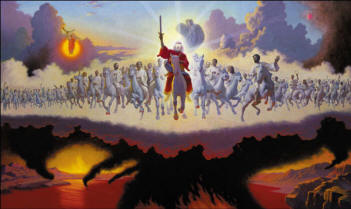
KING JESUS - LORD OF LORDS
IS COMING BACK!

email: creyner@yahoo.com

James 5:1 (KJV) Go to now, ye rich men, weep and howl for your miseries that shall come upon you.
Showing posts with label Pentecost. Show all posts

Saturday, June 7, 2014

Vatican "Peace," Pentecost/Shavuot, The Mark, "The Beast" Asteroid ...TONS OF NEWS

A high-level witch who converted to Christianity says there is only one thing that Satan really fears: an old-time Baptist preacher armed with a King James Bible. He is extremely dangerous because he knows the Word of God and he prays faithfully to his Father.. 

********************

DON'T MISS THE 'SIGNS TIMELINE' LINK BELOW VIDEOS
 
All of the videos below have news article links below the videos at YouTube site

Islamic Prayers Will Be Held At Vatican "Peace" Talks!


Mark of the Beast! Hidden RFID Chip Tracking, Exposed In ObamaCare


The Beast! Near-Earth Asteroid Will Fly By Earth Sunday!


Click Link:
(Click above link .. lots of good stuff here)

Friday, May 17, 2013

Shavuot - Pentecost - Rapture? A Few Final Thoughts

Part IV 

Shavuot was long considered to be a minor festival. It didn't really have its own day since it depended on the Passover date, and this seemed to make it "Part B" of the Passover in the minds of the Hebrews.And, added to this, the two loaves offered up contained leaven! 

Could its more electric importance be realized in Christianity? The Gentiles were certainly considered to contain leaven (sin). But the early Christian Church was full of Jewish believers, too. Could the two loaves represent Hebrew and Gentile believers?

Since the Church was born on Pentecost, could that day also foreshadow the day the Holy Spirit completes His work in the Church? He is, after all, the down payment of our inheritance, to be fulfilled at a later date.

The First Trumpet

When  God descended to the top of Mt. Sinai to give the Law, the people heard the first trumpet ever recorded in Scripture. It was terrifying. This event according to rabbinical tradition occurred on the very day that was later established as Pentecost.  

Michael Strassfeld, in his book The Jewish Holidays, a Guide & Commentary, writes: 

"At some point in the rabbinical period, connections began to be made with the Revelation at Sinai, which as the biblical text tells us, took place in the third month - that is, during Sivan (see Ex. 19:1). The exact date of Sinai is not given, and in fact there is a disagreement in the Talmud over whether the Revelation took place on the sixth or seventh of Sivan." (p. 71 

According to Jewish tradition, God took the two horns from the ram given to Abraham as a sacrifice in the place of Isaac. From them, he made two shofars. The left horn was called the "first trumpet" and was blown at Sinai. The right horn is called the "last trumpet" and will be blown on the day of Resurrection. The question is, will the last trumpet be sounded on Pentecost or on Rosh HaShanah? This early Jewish tradition was perhaps the origin of Paul's use of the term "last trump" in 1 Cor. 15:51-53). 

The Battle of Leviathan and Behemoth

Jewish legend also says that Pentecost represents the day of the dragon's conflict when God holds a feast for the saints where they celebrate the final battle of Leviathan and Behemoth. Interestingly, we read in Rev. 19:19,20 

19 And I saw the beast, and the kings of the earth, and their armies, gathered together to make war against him that sat on the horse, and against his army.
20 And the beast was taken, and with him the false prophet that wrought miracles before him, with which he deceived them that had received the mark of the beast, and them that worshipped his image. These both were cast alive into a lake of fire burning with brimstone.

This description, depicting the events that will occur when Christ returns in glory with His saints, immediately follows the account of the Marriage Supper of the Lamb. In Jewish tradition the bride and groom were in seclusion for the seven days preceding the marriage feast. And the feast itself seems to be in the context of the prophetic fulfillment of the feast of Shavuot - at least in legend. Every single year the rabbis tell this story of the saints in heaven watching the battle of the beasts, which is planting the seeds of recognition in the minds of the people. When that event occurs, the Jews will recognize it.

Those two beasts - Leviathan and Behemoth - seem to be referenced in Rev. 13:1, 11:

13:1 And I stood upon the sand of the sea, and saw a beast rise up out of the sea, having seven heads and ten horns, and upon his horns ten crowns, and upon his heads the name of blasphemy.

11 And I beheld another beast coming up out of the earth; and he had two horns like a lamb, and he spake as a dragon.

This Jewish story of this battle of the beasts is a part of their observance of Pentecost (Shavuot). The prophecies behind this feast were not completed at the descent of the Holy  Spirit 2,000 years ago. There are still some Pentecost prophecies yet to be fulfilled. 

Flavius Josephus Tells A Strange Pentecost Story

 This is a tantalizing story that I've always loved. Josephus recounts an event that occurred as long as seven years before the destruction of Herod's Temple in 70 A.D.

"... At that feast which we call Pentecost, as the priests were going by night into the inner court of the Temple, as their custom was, to perform their sacred ministrations, they said that, in the first place, they felt a quaking, and heard a great noise, and after that they heard a sound as of a great multitude, saying, 'Let us remove hence.'" (Wars, VI.V.111)

Could this sound be viewed as a prophetic reference to the Rapture? When the Rapture occurs we will 'remove hence.' Was that quaking, noise and shout foreshadowing the Rapture? Right now people are hearing strange sounds from the heavens all over the world. What does it all mean?

Ruth & Gentile Conversion

The following section came from prophecy scholar J.R. Church, now with the Lord.
***
Rabbi Yosef Stern (The Three Festivals) tells his constituency of observant Jews that Ruth, a Gentile, completes the message of the five books of Moses. Without her story the Torah would be incomplete. She is a "supplement to the Torah." This teaching, though not yet understood by Jews, underscores what happened on the day of Pentecost. That day began a dispensation in which millions upon millions of Gentiles have been brought into faith and fellowship with God. What a dramatic conclusion to the old Mosaic Covenant. Peter emphasized that Joel had predicted the pouring out of God's Spirit upon "all flesh," including all Gentiles.

Note the way Rabbi Stern describes Ruth's personification of righteousness: "Ruth dramatizes the theme expressed in the Mishnah (Avos 1:17 'Not study but practice is the main thing.' She, being a Gentile, does not just follow the Torah, but actually possesses it in her soul" Stern continues: "Torah is compared to an inner light (cf. Tehillum [Psalm] 97:11), light is sown for the righteous, the light of Torah is sown in the soul of the tzaddik." (p. 212). The Hebrew term tzaddik refers to a righteous person. 

The rabbi is saying that Ruth, unlike the ordinary Torah-practicing Jew, actually possessed eternal life. She did not just study the five books of Moses, but personified righteousness. Rabbi Stern writes:  "Similarly, the blessing recited after reading the Torah who implanted eternal life within us ..." implies that eternal life is a subject associated with Pentecost.  Furthermore, Jews believe that Ruth exemplifies the day when all nations will do as she did - receive eternal life through faith in the Messiah: "Just as Ruth made an important contribution to Judaism, so can anyone from any origin. Indeed, [God] actively waits for strangers to emerge from the clutches of the non-Jewish world." (p. 218) 

Ruth is an important and essential part of the Pentecost ritual. Rabbi Stern tells his Jewish followers that she is a prophetic type of all Gentiles who will be invited to receive eternal life. He writes that the reading of Ruth "... also reminds us of the final Revelation Day, a day as glorious as that on which the Torah was given, when Messiah ben David will appear. .. If [Pentecost] marked the onset of Jewish history, then Messiah's arrival will be its splendid climax, when all of humankind will flock to [God]." (p. 218)

What the rabbi does not understand is that the "splendid climax" to the Pentecost ritual actually came to pass 2,000 years ago and was recorded in the second chapter of Acts. Each generation after that has witnessed more and more Ruths until, today, the Gentile bride numbers into the millions. We are all awaiting the conclusion of what Rabbi Yosef Stern wrote about Ruth's association with Pentecost - the resurrection: " ... the reading of Ruth reminds us of Techiyas HaMeisim (resurrection of the dead)." (p. 219) 

Rabbi Stern writes that Boaz' redemption of the property of his relative Elimelech and his sons, and the ceremony he performed with Ruth, evokes Jewish faith in the"resurrection." By marrying Ruth, Stern says that Boaz "restored the name of her late husband and presents the concept of a "redeemer." In reality, all this was set forth in the second chapter of Acts and will be concluded when our Kinsman Redeemer, the Lord Jesus Christ, returns to resurrect and rapture all believers for the heavenly marriage. 

J.R. Church wraps up this excerpt by saying: Reading about Jewish ritual during their all-night vigil of Pentecost causes me to wonder why Jews have not seen these truths in Christianity.  It seems clear to me that every detail of Jewish practice was fulfilled there. I am certain that someday, Jewish eyes will be opened to the truth. Then they will realize that what they practice as ritual, we observe as fact.
 *** End of excerpt

Well. I'm exhausted from this 4-day review of Shavuot, or Pentecost, and completely astonished that some people do not find God's Word absolutely spellbinding. We can be certain that even with all of this information we are barely scratching the surface of what God has given us in His Word. This is why I find Bible research so particularly fascinating and rewarding.

The Christian Church owes a tremendous debt of gratitude to God for our spiritual ancestors, our Father Abraham, the Patriarchs, the faithful rabbis down through the ages, the apostles and Jesus himself. They have provided us with the material necessary to comprehend the Messiah and the entire eras of the Old and New Testaments. That is why I find it so personally excruciatingly painful to contemplate the 'time of Jacob's trouble' for our brothers and sisters in Israel.

It is thrilling to see the growing number of Messianic Jewish Christians. No doubt it will be from the witness of this group that the 144,000 will come to faith in the Messiah, Jesus.

Please pray for God's original chosen people, that many will come to understand the truth - and quickly. Pray for true peace for Jerusalem, which we know will only come through Our Lord's reign. Pray also for the Christians throughout the world, many who are under severe persecution. All of these are our brothers and sisters.

I write all of this information about Shavuot/Pentecost for you, my beloved readers! I fervently hope the Lord does come during this time, but am becoming satisfied to wait for His will on His appointed day. I have learned to wait, and so have you. Remember, patience builds character! I hope you have found this series enlightening as we all eagerly await the day of His appearing. Let's not neglect to pray for each other.

Even so, Come Lord Jesus!  

 ROYAL HEIR
Hamas Enforces Quiet Border With Israel 

Erdogan’s Great Gamble  -  Peace

Globe Grows Darker as Sunshine Diminishes 10% to 37%

Four colossal Sun flares in 48 hours

Weird, smelly mystery foam oozes through cracks in Chinese streets


Exo-Vaticana: Examining the Fatima “Miracle of the Sun”

Planet reeling from a swarm of earthquakes over last 72 hours


Thursday, May 16, 2013

Shavuot - Pentecost - Rapture? Part III

Boaz and Ruth

The Order of Resurrections

"23 But every man in his own order: Christ the firstfruits; afterward, they that are Christ's at his coming. 24 Then cometh the end ..."  I Cor. 15: 23,24

The early church father believed that Christ would appear at Pentecost. "The Church Fathers highly regarded Pentecost. Easter was always on Sunday, so Pentecost was also. Between Easter and Pentecost, there was to be no fasting. Praying was done standing, rather than kneeling. During this time, catechumens were baptized. Many expected, because the Ascension had taken place near Pentecost, that Christ would return in the same season." Zondervan Pictorial Encyclopedia of the Bible V. 4, p. 694.

The Good Man Has Vanished

The spring harvest is when fruit and grain crops come to maturity. Fruit is inspected and stored. Wheat is saved in the granaries. At Pentecost feasts two test loaves of the harvested wheat was prepared. Bread and fruit are typical of redemption, blessing and bounty. But, to Israel during the "time of Jacob's trouble" - the Tribulation - the harvest will not be a time of rejoicing. Instead, we see in Micah 7:1-6:

Woe is me! for I am as when they have gathered the summer fruits, as the grape gleanings of the vintage: there is no cluster to eat: my soul desired the firstripe fruit.
The good man is perished* out of the earth: and there is none upright among men: they all lie in wait for blood; they hunt every man his brother with a net.
That they may do evil with both hands earnestly, the prince asketh, and the judge asketh for a reward; and the great man, he uttereth his mischievous desire: so they wrap it up.
The best of them is as a brier: the most upright is sharper than a thorn hedge: the day of thy watchmen and thy visitation cometh; now shall be their perplexity.
Trust ye not in a friend, put ye not confidence in a guide: keep the doors of thy mouth from her that lieth in thy bosom.
For the son dishonoureth the father, the daughter riseth up against her mother, the daughter in law against her mother in law; a man's enemies are the men of his own house.
 "Perish" is translated from the Hebrew verb avad, meaning "to cause to vanish."

The time of which Micah speaks is the period of late April through early June, in the latter days at the time of the fruit harvest. He is comparing the situation to that of the grape harvest - but there are no grapes, and his soul is hungry for the good fruit ('the good man') that he believes has perished. There is no one good left on the earth; they are all evil. This appears to be a perfect description of the state of the earth after the Rapture.

What is he talking about in verse 4 above: "...the day of thy watchmen and thy visitation cometh; now shall be their perplexity: " Ancient Jewish expositions (without going into detail here) believed that this referred to an invasion of Israel from the North. Some of them believed this is a reference to Ezekiel's prophecy of Gog's invasion of Israel (Ez 38:15). The word here used for 'watchman' means both watch and north. For our purposes this is fascinating because that would link the rapture of the church with Ezekiel's prophecy of the northern invasion - a position taken by many Christian prophecy students in the past few years. 

First, the fruitful righteous are made to vanish, resulting in a time of unequaled horror when Israel realizes she has nary a friend on the face of the earth. Now is when her troubles really begin.

And it all starts with the early summer harvest.

Jesus prophesied about his own coming:
28 And when these things begin to come to pass, then look up, and lift up your heads; for your redemption draweth nigh.
29 And he spake to them a parable; Behold the fig tree, and all the trees;
30 When they now shoot forth, ye see and know of your own selves that summer is now nigh at hand.
31 So likewise ye, when ye see these things come to pass, know ye that the kingdom of God is nigh at hand.
32 Verily I say unto you, This generation shall not pass away, till all be fulfilled.   Luke 21:28-32

He is talking about the very beginning of a long process of events culminating in his reign on Earth, beginning with the judgment of the fruit of the trees, and also a metaphor of Israel in the latter days at the time of the spring harvest.

The bridegroom in the Song of Solomon also comes for his bride at the time of the spring harvest "when the vines with the tender grape give a good smell. Arise, my love, my fair one, and come away." This is a type of the Lord and his relationship with the church.

Ruth, the Gentile Bride  

Once again, we find the season at which Ruth became the wife of Boaz was in the late spring of the grain harvest. Their descendants include King David and the future Messiah himself. Ruth's first husband, a Hebrew, died, and she went with her mother-in-law, Naomi, to dwell in Bethlehem.

Ruth had no earthly goods, but was a poor widow who gleaned in the fields for food. She caught the eye of Boaz, the wealthy owner of the land, who allowed her to glean among the sheaves. At Naomi's instruction, Ruth laid down on the threshing floor at Boaz' feet on the night of the harvest, Pentecost. That very night he claimed her and, through his legal right as a near kinsman,  he married her. He knew of her virtuous reputation and completed her as heir to the Messianic promise through the lineage of David, her grandson through Obed, the son of Ruth and Boaz.

Starting out in a strange land this Gentile bride had only her faith. She is a picture of the church, the bride of Christ. 

Rabbinical authority and tradition calls for the Book of Ruth to be read at Shavuot (Pentecost). Michael Strassfeld, writing in The Jewish Holidays, a Guide and Commentary, p. 73, tells us why the Book of Ruth is read that night:

"1. The story is set at the time of the harvest.
  2. Ruth's conversion to Judaism is thought to bear a close resemblance to one's voluntary acceptance of the Torah and God's covenant at Sinai.
  3. King David, according to tradition, was born and died on Shavuot" [Pentecost].  
  4. Reading Ruth means that the totality of the Torah is celebrated on Shavuot, for Ruth is part of the .... writings that together with the Torah and the prophets compose the whole Bible." 

Even today, the Jews stay up all night in their synagogue, studying the tikkun - a book of selections from the Torah and the Talmud.  Strassfeld writes:

"... In this fashion they are prepared for the momentous revelation of the following morning....the sense is heightened by a mystical tradition holding that the skies open up during this night for a brief instant. At that very moment, we are told, God will favorably answer any prayer. They also regard Pentecost as the wedding of God and Israel. Therefore, we stay up all night to 'decorate the bride.'"

Is that a picture of the Rapture or what? The Jewish practices at this time certainly mesh with those of the Church. We, too, look for the sky to open 'in the twinkling of an eye.' And we will vanish without a trace.

Meanwhile, we must complete the tasks before us. Even so, come, Lord Jesus!

Royal Heir


Wednesday, May 15, 2013

Shavuot - Pentecost - Rapture? Part II


Counting The Omer

In Matthew 13:39, Jesus said, “The harvest is the end of the world.” By this, He meant that the events of the end times would culminate in a great harvest of souls.

In keeping with the harvest theme, the Jews honor Pentecost as the day reserved in heaven for the judgment of the fruit of trees. We are reminded of Christ’s own words: Wherefore by their fruits ye shall know them” (Matt. 7:20).
On Pentecost, He sent His Holy Spirit, creating the body of Christ – the church – as we know it today. Since that time, its goal has been to witness for Him, “to the uttermost part of the earth” (Acts 1:8). Christ likened evangelism to the planting of seed, which matures until the time of the harvest. His return for His people would be the next event in the Christian prophetic calendar. Significantly, after Firstfruits, the next important date on the festival calendar is Pentecost.

In the era of the Temple, Jews dramatically celebrated the feast of Firstfruits (Hebrew: Omer). On the Sunday following Passover, the high priest stood to offer the Omer, or first gathering of the grain harvest. In Leviticus 23:11, it is called, “the sheaf.” This offering was counted as day one. “Counting the Omer” then continued for fifty days, until Pentecost: 

15 And ye shall count unto you from the morrow after the sabbath, from the day that ye brought the sheaf of the wave offering; seven sabbaths shall be complete: 16 Even unto the morrow after the seventh sabbath shall ye number fifty days; and ye shall offer a new meat offering unto the LORD. 17 Ye shall bring out of your habitations two wave loaves of two tenth deals: they shall be of fine flour; they shall be baken with leaven; they are the firstfruits unto the LORD” (Lev. 23:15-17).

The above-mentioned “fifty days” typify redemption. For Jewish scholars, this period represents the maturing of the relationship between God and Israel. For Christians, it adds the feature of the coming of the Holy Spirit. Christ rose from the dead on Firstfruits (the Omer), and angels promised His return “in like manner.”

As Paul later put it, describing resurrection, “But every man in his own order: Christ the firstfruits; afterward they that are Christ’s at his coming” (1Cor. 15:23).

But there are hazards in farming to produce a harvest. Jesus often spoke of this fact:

37 He answered and said unto them, He that soweth the good seed is the Son of man; 38 The field is the world; the good seed are the children of the kingdom; but the tares are the children of the wicked one; 39 The enemy that sowed them is the devil; the harvest is the end of the world; and the reapers are the angels. 40 As therefore the tares are gathered and burned in the fire; so shall it be in the end of this world. 41 The Son of man shall send forth his angels, and they shall gather out of his kingdom all things that offend, and them which do iniquity; 42 And shall cast them into a furnace of fire: there shall be wailing and gnashing of teeth. 43 Then shall the righteous shine forth as the sun in the kingdom of their Father. Who hath ears to hear, let him hear. (Matt. 13:37-43).

Counting each day from the public exhibit of the Omer is the equivalent of watching crops grow. Anyone who has observed farmers in action knows that their routine is fraught with unpredictability that involves much anxious watching. In addition to tares and weeds there are pests, drought, disease and bad weather, all of which will threaten the final outcome of his crop.

The harvest will be accompanied by the equivalent of threshing. The good grain must ultimately be winnowed and finally ground into fine flour, worthy of baking.

The Wicked World

As given above in Leviticus, the fifty-day count begins with the first sheaf and ends with two loaves, each baked with leavening.

At Pentecost, the harvest of souls in the church age is complete. The two baked loaves held aloft by the priest are bodies representing the redeemed. They are lifted above the earth, suggesting an ascent to heaven. And they are baked with leavening.

But why would they be leavened loaves? We know that throughout Scripture, leavening is a type of evil, wickedness and depravity. At Passover, only unleavened bread was eaten. Jesus also warned his followers: “6 Take heed and beware of the leaven of the Pharisees and of the Sadducees” (Matt. 16:6).

Furthermore, He once told His disciples: “33 Another parable spake he unto them; The kingdom of heaven is like unto leaven, which a woman took, and hid in three measures of meal, till the whole was leavened” (Matt. 13:33).

Many have commented on His statement, saying that the three measures of meal represent the three groups of people spoken of in Scripture: Jews, Gentiles and the church. All have been tainted by the evil that requires redemption. The woman? She is none other than the figure of Mystery Babylon.

The above is an excerpt from an article by Gary Stearman in the May 2013 Prophecy in the News magazine.

It's extremely interesting to note the importance of Pentecost in the change of dispensations. Beginning with the Flood (and the Noahic Covenant) this date has marked the change of each dispensation: the change from Conscience to Human Government; the initiation of the Law; the change from Law to Grace. For this reason scholars should pay particular attention; there is certainly some significance in this, making it a higher likelihood that the Age of Grace might be marked by Pentecost in its transition to the end of the church age and the beginning of the time of Jacob's trouble. 

The Trumpets

My next blog will be about the Rapture significance of the Ruth/Boaz story. To this day Jews stay up all night studying the scripture in the hope of receiving a special blessing from God. They believe that the heavens will briefly open up and that the Holy Spirit will burst through to earth for a moment to bless in some special way those who are diligent.

 “51 Behold, I shew you a mystery; We shall not all sleep, but we shall all be changed, 52 In a moment, in the twinkling of an eye, at the last trump: for the trumpet shall sound, and the dead shall be raised incorruptible, and we shall be changed” (1 Cor. 15:51,52).

The above passage refers to that brief moment the Jews await on Pentecost. The first Trumpet of the Lord (His voice) sounded at Mt. Sinai at the giving of the Law. The last Trumpet (also the sound of the Lord's voice) will again sound:

“16 For the Lord himself shall descend from heaven with a shout, with the voice of the archangel, and with the trump of God: and the dead in Christ shall rise first: 17 Then we which are alive and remain shall be caught up together with them in the clouds, to meet the Lord in the air: and so shall we ever be with the Lord” (1 Th. 4;16,17). 

These two trumpets of the Lord - the First Trumpet and the Last Trumpet - are not ram's horns, and they are not metal instruments. They are the voice of the Lord. 
 

Tuesday, May 14, 2013

Shavuot - Pentecost - Rapture ?


Since we are in the period of the 4th Feast of Israel - Shavuot/Pentecost - one of the harvest feasts, I wanted to present some material on this feast this week. Since all seven of feasts have 1) a Hebrew name 2) descriptive names 3) Christian name, I decided to make a little chart for my own use since commentators often use the names interchangeably. No doubt it isn't complete (I'll continue working on it), but I thought I would put it on the blog so that if you want to print it out and use or add to it, it may be helpful in your own studies. The chart is first (below), then a brief summary. I will have another post or two on Pentecost following today's.

CHART OF 7 FEASTS OF ISRAEL

Seven Jewish Feasts – Historic and Prophetic

FIRST 3 FEASTS in the Spring of the year are associated with Christ’s First Coming
1) Passover – associated with sacrificial death
2) Feast of Unleavened Bread – associated with burial
3) Feast of First fruits (day after the Sabbath, or Easter Sunday)
  – associated with Resurrection and Christ, the first fruits.
 Then, “Counting of the Omer” begins, and lasts for 49 days. On the 50th day is the:

FOURTH FEAST, which is associated with the coming of the Holy Spirit – the birth of the Church. It also denotes the great harvest at the end of the Age (Mt 13:39, 7:20). Christ compares the evangelism of the Church to the planting of the seed which grows until maturity, the time of harvest.
4) Feast of Weeks / Shavuot / Pentecost (means “50”) – 6th of Sivan (May 14-15):
Associated with:    
     - Enoch’s date of birth AND the rapture of Enoch before Noah’s Flood on 6 Sivan.  3 groups of people involved with the Flood: those who perished; those who were preserved through the flood; Enoch, who was raptured before Flood.  
     - The birth of the Church - Pentecost (Acts 2)
     - 2013 Pentecost is also Israel’s 65th Birthday.
       Jewish Feast celebrated 5/14-5/15, Sivan 6-7
       Christian Pentecost: since the Bible always places it on Sunday, some say the  nearest Sunday (5/12 or 5/19 – the official 2013 Pentecost Sunday). The uncertainty of the date is typical, since Pentecost is called “the festival without a date.”  Its appearance, as originally calculated by the new moon, the Passover, and a 7-week countdown, is very flexible.
     - Male attendance compulsory
     - Reading of the Book of Ruth, traditional, story of Boaz the kinsman-redeemer taking a Gentile bride
     - Festive occasion
     - Commemorative of the date of the giving of the Law on Mt Sinai
     - Date of David’s death, according to tradition  
     - Only feast which uses leavened bread (leaven represents sin)
     - Harvest Festival, reserved in heaven for the judgment of the fruit of the trees

LAST 3 FEASTS in the Fall of the year are associated with Christ’s Second Coming:
 5) Rosh HaShanah/Yom Teruah – represents judgments of the Day of the Lord
 6) Yom Kippur/Day of Atonement – Christ’s appearance at the end of the Tribulation
 7)- Tabernacles/Succoth – establishment of Christ’s Kingdom and reign on earth

 * * * * * * *


Shavuot/Pentecost/Harvest - 4th Feast of ...
The Seven Feasts of Israel
 
The first five books of the Bible (Torah) spell out the seven feasts God put on the Hebrew calendar. The first three feasts are celebrated in the spring: Feast of Unleavened Bread (Passover week), and the Feast of First Fruits. Fifty days later there is the Feast of Weeks, Shavuot, also known as Pentecost. Then there are the three fall feasts, the Feast of Trumpets (Yom Teruah); the Day of Atonement, (Yom Kippur); and the Feast of Tabernacles (Succoth). 

While these were very important feasts on the Hebrew calendar, they also each have a prophetic role and each one is fulfilled in the Christian/Church era. Paul refers to their predictive roles as "a shadow of things to come." Jesus also pointed to his personal role in their fulfillment: “Think not that I am come to destroy the law (Torah), or the prophets: I am not come to destroy, but to fulfill.” Matthew 5:17. These are perfect examples of the saying: "The New Testament is in the Old Testament concealed, and the Old Testament is in the New Testament revealed." 

Shavuot, The Feast of Weeks, Pentecost - 4th Feast

The first three were prophetic of Christ's first advent. It is believed that the final three feasts are prophetic of Christ's Second Coming. Between these two groups of feasts is Shavuot, the Feast of Weeks, also called the Feast of Harvest, and Pentecost by the Church. 

What is the prophetic fulfillment of this feast? 

This feast was to be observed by a formula. The Hebrews were to begin counting on the day of the Feast of First Fruits ("the morrow after the Saturday Sabbath" - always a Sunday!), seven weeks (49 days) plus one day, totaling 50 days, and placing this feast also on a Sunday. The word “Pentecost” means “fifty.” 

Historically, this feast commemorates the giving of the Law at Mount Sinai. The observance of this feast is unique because it includes two loaves of leavened bread-the only use of leavened bread in all of the specifications of the Law. Leavening always represented sin, and it’s interesting that while the Passover emphasized unleavened bread (the sinless Lamb), Pentecost mentions leavened bread ... possibly a shadow of two sacrificial lambs – the leavening/sin representing a Gentile inclusion into the application of this feast.

Prophetic Application
 
The Church was "born" on the Feast of Pentecost. The Crucifixion fulfilled Passover and the Feast of First fruits. Pentecost followed exactly 50 days later, when the Holy Ghost appeared as tongues of fire – the birth of the Church in Acts 2. Many believe this was a partial fulfillment. 

Could There Be A Rapture Application? 

The sudden "snatching out" of the church (harpazo in the Greek; called the "rapture" from the Latin) is also seen as the completion of the Church Age. 

Many have believed that the rapture will be fulfilled at the time of the Feast of the Trumpets or the Feast of Tabernacles; on the other hand, many believe the three fall feasts are applicable only to the Second Coming when Christ arrives on the ground rather than meeting us in the air. (There are many other differences in the descriptions of Christ's return in the air vs. on the ground.)

But why would the Jewish feasts apply to the Church at all? The Scripture makes plain that there is a clear distinction between Israel and the Church. In Romans, Paul spends considerable time explaining that God is not finished with Israel. In Ephesians he also says that the Church was not revealed in the Old Testament, and yet here we are! When the temple veil was rent in two the Law was fulfilled in Christ. While many NT Jews recognized Christ as Messiah, the Bible is clear that the land of Israel and the Jews play a role unique from the Church, which exists during this 2,000-year interval now closing, after which comes the “time of Jacob’s trouble” and the culmination of God’s plans for Israel and Jerusalem. But, that’s another story. 

Enoch as a Clue?
 
Enoch was also raptured – and on that same date which we know as Pentecost – the 6th of Sivan. Tradition holds that he was both born and raptured on Sivan 6. He was the first person to prophecy of the Second Coming of Jesus Christ, and his prophecy was made before the Flood. Some view Enoch's birth and rapture on Sivan 6 as a foreshadowing of the rapture of the Church. It is interesting that three groups of people were involved in the flood: those who perished, those who were preserved through it and Enoch, who was raptured. Why is the Book of Enoch mentioned so often in the Bible - even by Christ Himself?

If Enoch was, as rabbinical tradition asserts -  born on Sivan 6 and raptured on Sivan 6, that means he was raptured on his birthday. Is that a foreshadowing of the Church being raptured on its birthday, Pentecost? Did the Jewish clock stop at Pentecost, to be restarted on Pentecost once again at the rapture of the Church? We cannot say for sure, but this is the kind of consistency that occurs time and time again in God’s time table, and which has allowed Christians to decipher prophecy through long and diligent study.. None of this is accidental. Is this one more clue that God promises will be revealed to those who are serious students of God’s Word? Only time will tell.

Is The Book of Ruth Another Clue? 

Some have wondered why the Book of Ruth is even included in the Bible. What is its purpose? 

The Book of Ruth is the primary OT book most closely relating to Jesus Christ and his bride, The Church. because the Book of Ruth portrays Boaz in the role of the kinsman-redeemer who takes a Gentile bride.

The Two "Rapture" Feasts?
 
The two feasts most often associated with the Rapture are the Feast of Trumpets (Rosh HaShanah) and the Feast of Weeks, Pentecost (Shavuot). 

But to be thorough, Rosh HaShanah is not the only feast linked to resurrection/rapture. There are at last three harvest festivals which form prophetic statements on resurrection, all three required all Jewish men to travel to Jerusalem and “appear before the Lord.” These are Passover week (Feast of Unleavened Bread), Pentecost (Feast of Weeks) and the Feast of Tabernacles (Dt. 16:16). Any of these three harvest festivals could represent Resurrection Day / Rapture when we meet the Lord in the air.

The next blog will cover the Counting of the Omer, the period between Passover and Pentecost - the 50 days.

NOTE: Regular readers must know that I am of the Pre-Trib Rapture school. I actually began as an amillennialist many years ago. I thought the Rapture was a silly American 'get-out-of-jail-free' card. Ridiculous. 

After many years, and thousands of hours of study (including all schools of thought), I came slowly and surely to this position. I seriously doubt if anyone can come up with any position which I have not already studied ad nauseum, and therefore I am not likely to change my mind. I only have it furthur confirmed as I continue studying the Word. Despite all of this, I do not lay claim to certitude (I'm not a fool :-)  I never care about being right - only about discovering truth. The Lord will come at His appointed time, and this is the blessed hope of all prophecy students who look for Him to return. Maranatha!

More tomorrow ... Royal Heir